

Pico’s Project Swan: A Strategic Tease Signals the Next Phase of Spatial Computing
Pico unveils Pico OS 6 — its most significant operating system update yet — and teases Project Swan, a next-generation XR headset set for global launch in late 2026. Positioned as a spatial computing platform rather than just a VR device, Swan signals ByteDance’s bold move into premium immersive productivity.
 Anupam Saikia
Mar 3, 2026 10:47
403
0
Anupam Saikia
Mar 3, 2026 10:47
403
0
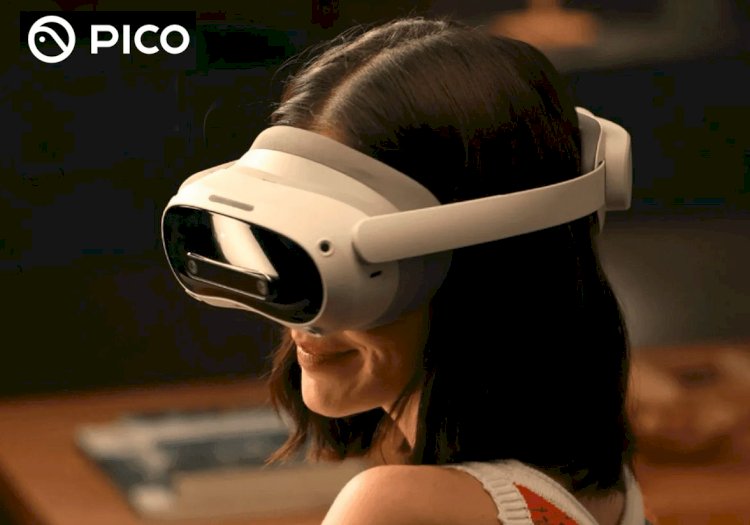
Aiidesh Newsdesk | 3 March 2026
ByteDance is the global technology company that owns TikTok, one of the world’s most popular short-video platforms with millions of daily users. The company has been quietly expanding into advanced technologies — including Artificial Intelligence and Virtual Reality.
Through its XR-focused subsidiary Pico, ByteDance has steadily built its presence in the VR industry. Now, with the teaser of Project Swan, Pico appears ready to enter a more ambitious phase: premium spatial computing.
Earlier Pico headsets, such as the Pico 4, were largely aimed at entertainment and gaming audiences. Project Swan, however, is being introduced alongside Pico OS 6, a new spatial operating system designed for multitasking and productivity.
Pico has described Pico OS 6 as its most significant operating system update to date. Rather than unveiling full hardware specifications first, the company chose to spotlight the software foundation that will power Swan. This shift in emphasis signals a strategic repositioning — from device manufacturer to platform architect.
Project Swan is confirmed as Pico’s next flagship headset, with a planned global launch window in late 2026. While pricing and finalized hardware specifications remain undisclosed, the company has begun sharing directional features and is preparing for a live demonstration session at GDC 2026 next week, where developers are expected to see the system in action.
This indicates that Swan is not merely a hardware refresh — it may be positioned as a spatial computer.
Industry comparisons naturally point toward devices like Apple Vision Pro from Apple, the broader ecosystem led by Meta, and Samsung’s recently introduced XR initiative — including its upcoming mixed-reality headset being developed in collaboration with Google under the Android XR platform (often referred to as Project Moohan). However, Pico appears to be carving its own path by emphasizing openness, Android compatibility, and greater flexibility for developers.
What We Know So Far
While full specifications have not been officially disclosed, reports indicate that Project Swan may feature:
- High-resolution micro-OLED displays for sharper visuals
- Improved pixel density aimed at better text clarity
- Advanced hand and eye tracking
- A dual-chip system for better performance and lower latency
- Support for both 2D and immersive 3D applications
If accurate, these features would place Swan in the premium XR category — targeting professionals, creators, and productivity-focused users rather than only gamers.
The global technology race is increasingly shifting toward spatial computing — blending physical and digital environments into a unified experience. Companies are exploring how virtual monitors, immersive collaboration, and AI-assisted workflows can replace traditional screens.
With Project Swan, ByteDance’s Pico division is making it clear: it intends to be part of that future.
As of now, pricing, release dates, weight, and full hardware details remain undisclosed. But even with a single teaser image, the message is strong.
Project Swan is not being introduced as just another headset. It is being positioned as a step toward the next era of computing.